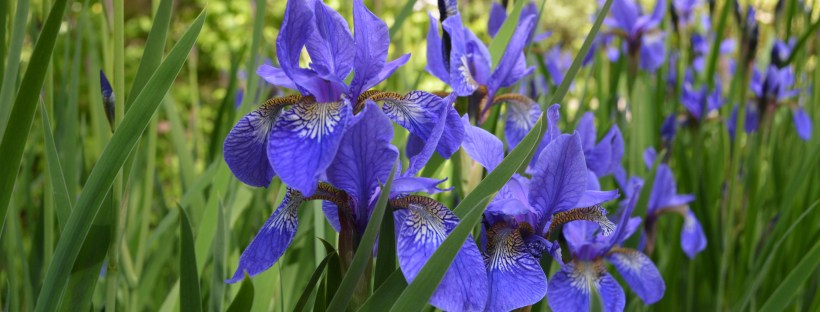
Keep your eyes open for these invaders!

Think Big Picture here.  You have your beautifully landscaped garden or are working towards it.  Your plants are thriving and you are in a routine of loving maintenance. To keep your garden happy, you need to keep your eyes out for intruders, of the plant variety.  Now, is the time to add INVADERS to your knowledge gardening bucket.  Understanding what to look for and why will be 100% beneficial the success of your garden and ultimately your bottom line.

Black Swallow-wort 
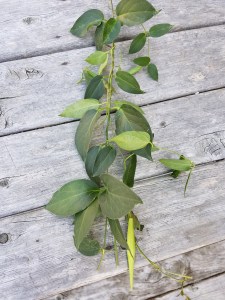
20170901_101828

is a vigorous twining vine that envelopes trees and shrubs. It spreads by wind-blown seeds and below ground. It forms thick stands which eliminate all native vegetation in its path. To make matters worse, it also confuses the Monarch Butterfly which recognizes Black Swallow-wort as Milkweed. Unfortunately, the Monarch’s eggs die if they are laid on Black Swallow-wort. To control without using pesticide you can dig up small plants with all the roots. At a minimum, pick off all green pods to prevent dispersal. To control using herbicides and spray on the leaves.

Porcelain-berry 
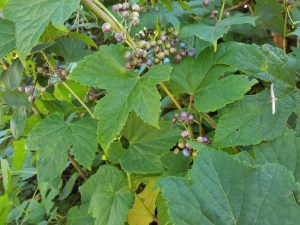
20170901_102008

has a very pretty blue/purple/white fruit, but don’t be fooled, this plant can take over! It is quick spreading forming carpets over open ground or heavy walls over forest edges. The grape-like leaves are borne on thin, woody vines which grow   15 – 20 feet a year! To control without pesticide you can clip and untangle some of the webs (before fruiting) 2- 3 times a year. Its root system is impossible to dig out. To control with a herbicide, spray leaves with herbicide before fruiting.

Japanese Knotweed 
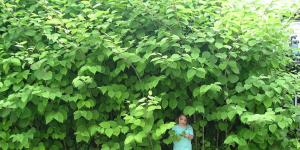
AF5B9906-3745-4C04-9FED-1A51319D7D49-2830-00000227D63ED85C

was imported into this country for its novel late summer flowers. It was also used for erosion control. It aggressively spreads along waterways and highways forming pure stands. Japanese Knotweed grows in sun or shade and eliminates all native plants in its path. It is a bushy shrub-like plant with heart-shaped leaves and attractive fleecy sprays of white flowers in late summer. It survives droughts. It is difficult to eradicate. Non-chemical; you can dig up young shoots. Cut back every month between May – October. With herbicide use Triclopyr injection to cut stems to the entire colony. Repeat as needed next year.

Have you found any of these invaders in your garden?  How did you get rid of them? Share with us below or ask any questions too.

The Perks in Growing Native Plants

Have you ever considered the benefits of native plants?   Native plants have beautiful flowers and foliage and are well adapted to the climate and soils in New England.  They offer real benefits to both the home owner and the local fauna.

The birds, insects and soil organisms will thank you for planting native material, which will in turn help and nurture the environment.  As a home owner, native plants will save you on valuable resources such as water and fertilizer.

Some examples of the most valuable woody plant genera in terms of supporting biodiversity in New England include: Oak, Crabapple, Blueberry, Maple and Spruce to name a few.

Some of the best perennials for supporting wildlife include Aster, Helianthus, Joe Pye, Carex, Lupine, Geranium, Black Eyed Susan, Iris, Milkweed, Phlox and Bee Balm.

Native plants may even improve your home’s real estate value, as more and more people are attracted to sustainable landscapes. What benefits have you seen of using native plants in your garden?

5 Reasons to Hire a Landscape Professional

Why hire a landscape professional you ask? Why spend the money? Why spend the extra time it takes to plan your landscape?

Years ago, when I was starting out on my own, a client told me an interesting story – their light bulb moment – that I have never forgotten. They said that they had made so many costly mistakes with their landscape choices over the years, that they decided it made good sense to hire me to help them with their new addition rather than go it alone. They realized it would cost them less money and they would end up with a much better product, if they worked with a professional instead of trying to do it all themselves.  My client had had that ‘ah ha moment’ which resulted in a phone call to me.  Have you ever had that ‘ah ha moment’ with a project of your own, whether it be landscape or maybe a renovation, that perhaps should have been handled by a professional?

As a creative, I appreciate the desire to do things yourself.  And depending on your skill set, talents, hobbies and desires – achieving them on your own is possible.  However, landscapes require maintenance, understanding and nurture – there are lots of variables with seasons, positioning and not to mention the plethora of planting options available. It would be in your best interest to consult a professional, so you can get it right the first time and can enjoy your properties potential sooner rather than later.   To make it super simple, this list helps articulate just what hiring a professional can help achieve.

5 reasons why you need to hire a Landscape Professional:

  1. Experienced horticulturalists can help you avoid costly mistakes
  2.  They can solve problems and maximize the potential of your property
  3. A designer will find creative ways to produce an outdoor space that reflects your needs
  4. They are trained in addressing site concerns such as drainage, screening and soil conditions.
  5. A Landscape designer will work with contractors, who they have built working relationships with, and provide you with a budget range to help you determine whether to build the project all at once or to phase it in over time.

If you are located in Metrowest Boston area or Rhode Island, I would welcome the opportunity to discuss your properties landscape needs.  Please call or use the contact form to reach out and start the conversation on how together we can transform your properties potential.